
With Putin’s barbaric unprovoked invasion of Ukraine, evil has been visited upon Europe on a scale, and at a level of threat, not seen since World War Two. Irish Prime Minster Michael Martin has called Putin an evil man, while Ukrainian President Zelensky has called on his fellow citizens to drive Putin’s evil out of their country.
Evil is a word that many people recoil from, with its metaphysical implications of demons and the Devil. But the reality of Putin’s evil is much more mundane. The source of his evil lies in the fact that Putin is an extremely damaged human being. That damage, which is variously called malignant narcissism, narcissistic personality disorder, or psychopathy, is manifest in one central aspect of his personality. Putin is incapable of normal human feeling. The damage that Putin suffered during his early childhood, when the essential capacities for relationships with, and empathy for, other human beings are usually formed, was such that he has been left bereft of any ability to see and relate to other people as people.
Putin’s mind, damaged beyond repair by severe abuse or neglect, has been frozen since childhood into a state devoid of empathy or love. Without these vital conduits for communication with the world of other people, and incapable of pursuing sustenance from the love and friendships that give life meaning, he has sought instead to force recognition and respect from others through terror, wealth and power.
Early in his career as a Communist revolutionary, Mao Zedong discovered his passion for cruelty. He realised that violence, which he found thrilling, terrified most normal people. This enormous advantage – his incapacity for human feeling and others’ terror at what came so easily to him – was something he exploited his entire life. When the Chinese Communist Party came to power, Mao’s first act was to order mass public executions in towns and cities right across China so that men, women and children could witness first-hand the mass terror one man can inflict if he is without feeling.
So too with Putin. His entire political career has been based on murder, war and the threat of terror. Now, with thousands of nuclear weapons under his control, he blithely threatens the world with nuclear war.
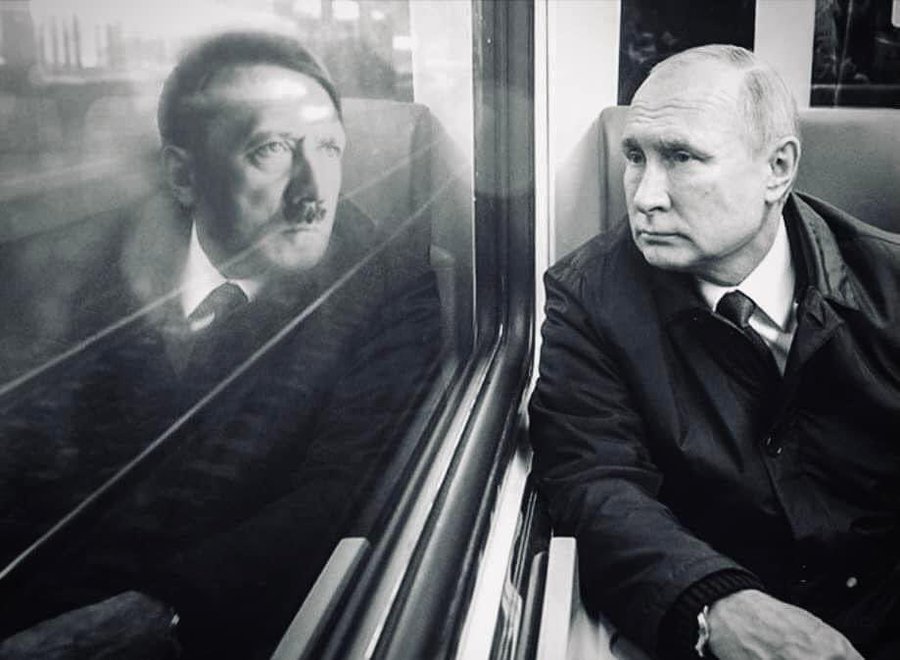
Our response to Putin is understandably to be terrified. But such a response plays into his hands. Putin is not an evil ‘genius’. Nor is he insane. He is simply an extremely damaged human being who is incapable of relating to other people with any semblance of humanity. His condition is untreatable. Only when we face this simple reality can we understand the nature of the threat we are facing.
When Putin sees the images of suffering coming out of Ukraine – of fathers in tears as they say goodbye to their wives and children because they have to stay and fight, of a female teacher splattered in blood because her apartment has been shelled, of a father weeping over the corpse of his teenage son – he does not feel sympathy or horror as we do. He feels contempt and satisfaction. He thinks, as Stalin did when he was signing the execution orders of tens of thousands of Russians, that no-one will remember this ‘riffraff’ a few years from now.
When Putin sees the bombed-out ruins of towns and cities, he doesn’t see the senseless destruction that we see. He sees beauty of a world bent to his will. While Ukrainians dream of reuniting with their families and living again in the peace they enjoyed before Putin unleashed his psychopathic violence, Putin dreams of the restoration of the Soviet Empire. This too is a reflection of his disorder. People with the dangerous personality disorder that Putin shares in common with Hitler have minds closed to change. Without the essential flow of benevolent and empathic human interaction with others, their minds do not grow. Instead, they fester for a lifetime on perceived injustices from decades past, fuelled by an unceasing paranoid hatred for the world. Hitler was fixated on Germany’s humiliation in the defeat of World War One, which he sought to rectify through the carnage of World War Two. Likewise, Putin is fixated on the ‘humiliation’ of the fall of the Soviet empire, the reversal of which he is prepared to pursue, quite likely, up to the point of nuclear war.
Commentators have suggested that power has corrupted him, or that he has changed in recent years. Both of these explanations miss the point. Putin’s damaged mind has been frozen, incapable of real learning or adaptation to a changing world, since he was a child. He has not changed, but the world has, leaving him more and more divorced from the reality around him – a 19th century mind in the 21st century as Angela Merkel described him. Rather than use his time in power to bring Russia forward into the future, his ossified mind is dragging it, and the world, back to the barbarism of its past.
Putin relates to the world by evoking terror because he lacks the human capacities to relate in any other way. The terror he evokes magnifies his power because it paralyses us and allows him to get his way. But the Ukrainian people, under President Zelensky, have shown us that beyond the terror, there is the need, and the will, to act. The world has allowed, yet again, a pathologically disordered man to rise to power and threaten the world. Such instances have been resolved in the past only through cataclysmic bloodshed. Let us hope that this time we can find another way. If and when we do get the chance to act, we must ensure, once and for all, that such damaged and disordered minds never again acquire power over us.
Ian Hughes is author of Disordered Minds: How Dangerous Personalities Are Destroying Democracy
 disorderedworld
Psychopathy is believed to be genetic. Perfectly decent parents can have children who are psychopaths.
‘Nature, and possibly some unknown biological influences on the developing fetus and neonate, provide the elements needed for the development of psychopathy – such as a profound inability to experience empathy and the complete range of emotions, including fear.
Several studies indicate that child abuse (physical, emotional, sexual, neglect) is associated with some components of adult psychopathy, as measured by the PCL-Rl. However. the associations typically are weak and apparently dependent on the type of abuse involved, and on the dimension or factor of the PCL-R.’
p32, ‘Snakes in Suits’, Babiak and hare, 2019
Sorry to necro this. But it seems reasonably evident to me that in a species of social animals, some will be born without the ability or desire, and yet have basic drives for survival, the combined drives of every cell in the living structure. The moral and social awareness from the newer parts of the brain appear to work to check those drives which would otherwise be unlimited, which is the accumulated wisdom of the reincarnated organism. Limitations are ‘switched on and off’ genetically are they not? The way lifespan of the organism is similarly ‘fated’. I felt a switch on my 30th birthday from growth to maintenance. Raising other species, I’ve noticed the switch of decay especially in the very small critters, it’s very noticeable due to the rapidity of aging. Renée Girard comments that stories featuring what can be identified as a psychopathic personality occur throughout the world in disparate mythologies.
My point being I suppose, that psychopathy is also part of this accumulated wisdom, which we might term generational trauma. Some could be born ready for the domestic abuse they are born into, or anticipate a great, glorious and chaotic war that breaks out in their 20s. I’ve met very few people who, in desperate conditions, have not at one point or another wished to break from all feeling as a means to resilience. An ex-soldier volunteering in a scientific trial about PTSD is recorded as saying; “At first, I hated it. Then I was just doing my job. Then I felt nothing about it. Then I enjoyed it.” It’s called appetitive aggression or more colloquially ‘combat high’, and functions like addiction. And the studies point towards symptoms of PTSD being much lower in those who could enjoy the cruelties they were inflicting. And rates of PTSD being higher in those who were forced to be witnesses or victims rather than perpetrators.
https://www.ncbi.nlm.nih.gov/pmc/articles/PMC4700207/
https://www.frontiersin.org/articles/10.3389/fpsyg.2015.01756/full
I last checked several months ago but I’m sure there have been more recent developments I’ve yet to explore.
Thanks for your really interesting comment. I agree – psychopathy, malignant narcissism and paranoid personality disorder may have survival value in dysfunctional circumstances, but they also seem to be driving us towards extinction. I would argue that the challenge is to change the systems of (politics, economics, gender, religion,) that help dangerous personalities to gain positions of authority. They will always be with us (probably) so we need to reimagine our societies to minimise their chances of gaining power over us. As things stand, they are often at a distinct advantage.
Sounds like a great idea for a near-future science fiction to me.
Sorry for the delay and then having such a short message, but I realised all I needed to comment more was that power itself that shapes the brain into these antisocial configurations. I believe all things must change and as such, all we experience now are transitory conditions. In the meantime though I would probably opt for redistribution of power, but it requires members of society to be “independent, creative agents” in the words of Huxley. People need more access to personal power, so as an artist, I know that one way of accomplishing that is promoting the arts. God, they hate the arts don’t they? Heh, I know why~
It just really seems better that nobody should have that much power. It could even be considered a cruelty, it just produces stressed apes.