
Reimagining a More Just and Sustainable Society – The Role of Critical Theory
“A new categorical imperative has been imposed by Hitler upon unfree mankind: to arrange their thoughts and actions so that Auschwitz will not repeat itself; so that nothing similar will happen.”
Theodor Adorno
Introduction
This blog is based on Stuart Jeffries’ wonderful book Grand Hotel Abyss which covers the lives and thought of the Frankfurt School of philosophers, whose leading figures include Walter Benjamin, Theodor Adorno, Max Horkheimer, Herbert Marcuse, and later Jurgen Habermas. Beginning in the 1920s, these thinkers passionately struggled to understand the reasons for Hitler’s mass support in Germany, the appeal of Stalinist Communism, and the destructive appeal of unregulated consumer Capitalism. Their deep understanding of culture, how forms of culture can lead humanity to barbarism, and why culture is so difficult to change, are still hugely relevant today as we stare, again, into the Abyss – of climate change, war, and global instability.
What is Culture?
Since coming to power, China’s leader Xi Jinping has imposed a policy of “comprehensive national security” aimed at securing political stability and defending the Chinese Communist Party’s hold on power. Xi’s policy of the “securitization of everything”, reaching across politics, economics, technology, control of religion, gender norms, and education, is deemed essential to the Party’s, and by extension China’s, survival. A similar regime of control over all aspects of society is currently being imposed in Putin’s Russia, and is familiar as the modus operandi for totalitarian regimes from Stalin, Mao, and Hitler, to present day North Korea.
Xi Jinping’s understanding of culture, in this broad sense of encompassing all the major social institutions in society, is one that he shares with the founders of the Frankfurt School and their Institute of Social Research. Under its Director Max Horkheimer, the Institute’s mission was to understand the nature of culture, which they defined as encompassing the economic life of society, the psychological development of individuals, and the realm of the everyday culture – which encompassed not only science, art and religion, but also “mass culture” in the form of lifestyle, mass media, public opinion, work and leisure, and more.
The founding thinkers of the Frankfurt School lived in unthinkable times. They lived through the rise of Hitler, when they were forced to flee Germany, the Second World War, the use of atomic bombs on Hiroshima and Nagasaki; and the industrial scale mass murder of the Nazi death camps. They were writing at a time when Capitalism, Stalinist Communism and National Socialism were all viable and rival social systems. Their experience of all these forms of society led them to the conclusion that, as Walter Benjamin wrote, “There is no document of civilisation that is not at the same time a document of barbarism”.
The aim of the Frankfurt School was to challenge cultures which had become impotent to change and which helped hold oppressive forms of society in place. In place of conformity and resignation, they sought to create a space for critical thought, a space for fostering progressive social change.
What is Critical Theory?
The value of the Frankfurt School lies in their methodology, as much as in the specific issues they addressed. They were of their time in terms of adhering to some of the ideas of Marx and Freud which have not aged well. Nevertheless, there is huge value in the core of what they developed.
Critical theory is first and foremost a normative critique of existing forms of society. It is a methodology “aimed at negating existing states of affairs that oppress individuals and restrict human freedom and wellbeing.” Critical theory, therefore, is unapologetic about making value judgements on particular forms of society, based on the absence of freedom, justice, and wellbeing. As Marcuse wrote. if a particular form of society lacks the freedom, material wellbeing and justice that would allow it to fulfil its potential, then the job of the critical theorist is to condemn that society as a “bad form of reality, a realm of limitation and bondage”. Empiricism, of course, is unable to do this. In fact, science explicitly excludes ‘value judgements’ as ‘unscientific’ – the basis of one of the Frankfurt Schools critiques of science, as we shall see.
Critical Theory’s methodology is holistic and dialectic. By holistic we mean that all social institutions in society need to be considered together – economics, politics, technology, religion, gender, education. Critical theory takes as its subject of study both the existing forms of these individual social institutions and the relationships and hierarchies between them. It holds that no social institution is ever fixed or complete, nor can any social institution be considered in isolation from other social institutions. Instead, social institutions are in a constant process of dialectic change with one another.
So, what did the term dialectic mean to the Frankfurt School? The term is essentially derived from the philosophy of Hegel who posited dialects, the confrontation of opposites, as the process through which thought – and history – progress. The dialectic process begins with a moment of fixity in which concepts or forms are seemingly stable. This is followed by a period of instability in which internal contradictions and oppositional ideas emerge. This confrontation between opposites results in new concepts and forms – changes in thought and history.
Unlike Hegel, who asserted that history, unfolding through dialectal processes, is the march of human freedom towards the Absolute, or the expression of World Spirit, Adorno opposed the idea that dialectical historical processes have a goal. Adorno rejected the idea that the narrative of history was destined to conclude with a happy ending. He viewed in the Enlightenment the substitution of one happy ending – religious salvation – with another – scientific and technological progress. Modernity, he argued, has simply substituted God with scientific and material progress, a new chimera which the State has been charged with pursuing.
Critical Theory then aims to be a method for a fuller understanding of society than Modernity’s science-fixated paradigm will allow. With its holistic and dialectic approach, it is inherently interdisciplinary, requiring insights from across the whole spectrum of human knowledge. It is a method that employs ‘negative thinking’ for radical cultural change.
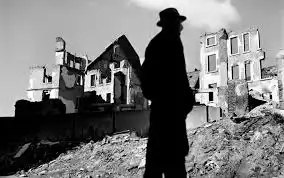
A man gazes upon the ruined city of Frankfurt, Germany, 1946. Photo by Werner Bischof/Magnum
Critique of Science and Critical Theory’s Potential Complementarity to Science
The authority of scientific, particularly mathematical, fact over other forms of knowledge is part of the current paradigm of Modernity. Science achieved this ascendency during the Enlightenment by critiquing previous dominant forms of thought, particularly religion. But now that Science is at the top of the knowledge hierarchy, the Frankfurt School asserted that it too needed to be critiqued.
Critical Theory refutes two widely accepted claims of the dominant scientific narrative. First, that the “scientific method” yields a true and complete picture of reality, superior to other non-scientific forms of knowledge. Second, that science is an objective search for truth that stands outside, and independent of, the political, economic, and cultural context within which it is conducted. The Frankfurt School rejected science’s claims of both superiority and absolute objectivity.
By understanding the Frankfurt School’s position on these issues, we can see how science and critical theory need not be in opposition, but can in fact be complementary methodologies.
Consider first the claim that science yields a true and complete picture of reality, superior to other non-scientific forms of knowledge. There is in fact no single ‘scientific method’. Instead, there are a number of tools, ways of thinking, and collective practices through which scientific knowledge is gained. Foremost among these are empiricism, induction, and falsifiability. Empiricism is the theory that all knowledge is based on experience derived from the senses. This forms the basis for science’s use of observation, experimentation, data collection, and analysis.
Induction is a process of reasoning, based on data gathered from observation. For example, after myriad observations of swans, all of which are white, one could hypothesise, through the process of induction, that all swans are white. Falsifiability is the principle that any given hypothesis can only be taken as a probability, and is always open to being proved wrong – for example, a black swan may turn up and disprove the hypothesis.
In addition, science uses mathematics as its primary language – scientific observation, theory building, and hypothesis testing all rely predominantly on quantitative data and mathematics.
This basic outline of science’s methodology provides the basis for understanding the Frankfurt School’s critiques of science.
The Frankfurt School categorically rejected the claim that science provides a complete picture of reality. As Horkheimer was at pains to point out, whatever cannot be calculated and formalised falls out of the picture that science creates of the world. As a result, that created world is a distortion – a picture in which huge swaths of knowledge and experience are discounted, including ethics, meaning, aesthetics, and value.
The Frankfurt School’s second critique is that science is not as aloof from its political, economic and culture context as its practitioners claim. On the contrary, scientific theory has been used time and again to justify particular forms of social order. One striking example of this is illustrated by the Nazis and Social Democrats in Germany and Austria in the 1930s. At that time, there were two contesting theories of evolution – a version of Darwinian natural selection in which it was believed that stronger genes could be selected for through selective reproduction of ‘stronger races’; and a Lamarckian theory of acquired characteristics, in which it was thought that the gene pool of the whole population could be enhanced by improving childcare and maternal health. The Nazis championed the former theory, the Social Democrats the latter. While science claims to stand aloof, Critical Theory says that science does not stand apart from the culture within which it is being conducted. Science is continually being used to serve the imposition and preservation of power.
The reason that the Frankfurt School’s critique of science was of such importance was not simply for reasons of philosophy, or concern for the status of non-scientific disciplines. It was because reducing the world to hypostatised facts has serious consequences.
In ‘Dialectic of Enlightenment’ Adorno and Horkheimer traced the consequences of science’s false claims to absolute objectivity and superiority: “Thinking objectifies itself to become an automatic, self-activating process, an impersonation of the machine that it produces so that ultimately the machine can replace it.” From this follows what Max Weber called the disenchantment of the world, the rationalisation of all areas of human endeavour. From disenchantment follows reification – the making of thing into human and human into thing with the result that humanity, ultimately, is dispensable. Nature has become what can be registered mathematically. Thought is equated with mathematics.
The scientific method – observation (empiricism), induction, and falsifiability – all add up to a radical tool for discerning ‘reality’. But Science, shorn of the pretences of absolute objectivity and superiority, can be seen as complimentary to the Critical Theory. Some problems are amenable to investigation with scientific method, including, for example the age and structure of the Cosmos, and the structure of matter. Other problems – wicked problems – like climate change and injustice, cannot be addressed by science alone. Both Science and Critical Theory are needed to fully understand and address such problems – and crucially, to reimagine new forms of society which do not create problems of such scale in the first place.
The Unfinished Project of Modernity
The most recent of the Frankfurt School’s leading thinkers, Jurgen Habermas, celebrated the positives of Modernity and the Enlightenment. We have benefitted, Habermas argues, from Modernity’s ‘positives’ of technological progress, economic growth, and rational administration. Modernity freed the West from the monotheistic Judeo-Christian tradition and enabled the emergence of a secular morality. Inviolable rights ensure human autonomy and flourishing. But there have been negative consequences too. Enlightenment thinkers had hoped that the arts and sciences would not merely promote control of the forces of nature, but also further the understanding of self and world, the progress of morality, justice in social institutions and even human happiness. That, Habermas argues, has not happened, because money and power have frozen a particular configuration of culture which imposes constraints on human action. Therefore, while Modernity has a sound core, it is still an “unfinished project”.
Among Habermas’ areas of critique are the effectiveness of democracy, the dangers of nationalism, and the role of religion in reimagining a more just society.
On democracy, his main concern has been to work out how “the citizens of a political community could still exercise collective influence over their destiny through the democratic process”’ He has consistently opposed the relativism of postmodern thought, as expounded by Lyotard, Foucault, and Derrida, because he holds that it undermines rational democratic debate. It does so by silencing oppositional voices, and by flirting with irrationalism and nihilism.
On religion, Habermas insists that one of the powerful legacies of the Enlightenment was the rise of secular morality and the decline of religious authority, which allowed us to think for ourselves and develop our own conception of the good. However, he also argues that if Modernity is to recover its ethical substance, engagement with religion is essential. The liberal state, he wrote, should “treat with care all cultural sources on which the normative consciousness and solidarity of citizens draws.” In doing so, Habermas has made a break with his former members of the Frankfurt School by acknowledging the place of religion in critical theory.
Habermas views nationalism too as a threat to democracy. Instead he argues for a “constitutional patriotism” in which people would take pride in the fact that they had succeeded in establishing a just political order and anchoring it in a liberal culture in which all ethnicities, religions, genders and cultures can feel at home.
Why Reimagining Contemporary Culture is So Important
Recall Benjamin’s statement, “There is no document of civilisation that is not at the same time a document of barbarism”. The Frankfurt School felt passionately that culture needs to be critiqued and reimagined for the demonstrable reason that culture has repeatedly driven humanity to new barbarisms.
Critical Theory is therefore important for two vital reasons. First, because it seeks new forms of society that reduce oppression and suffering; second, because by acknowledging that humanity has repeatedly adopted forms of society that have driven us to new barbarisms, it seeks forms of society that can avoid yet another such repetition. In the words of Adorno’s new categorical imperative, quoted at the beginning of this article, humankind must “arrange their thoughts and actions so that Auschwitz will not repeat itself; so that nothing similar will happen.”
Walter Benjamin invoked a powerful image for the essential task that Critical Theory has set itself. Benjamin invoked Paul Klee’s painting ‘Angelus Novus’ as a metaphor for our current predicament. The painting shows an angel looking as though he is about to move away from something he is contemplating.
“This is how one pictures the angel of history. His face is turned toward the past. Where we perceive a chain of events, he sees one single catastrophe which keeps piling wreckage and hurls it in front of his feet. The angel would like to stay, awaken the dead, and make whole what has been smashed. But a storm is blowing in from Paradise; it has got caught in his wings with such a violence that the angel can no longer close them. The storm irresistibly propels him into the future to which his back is turned, while the pile of debris before him grows skyward. This storm is what we call progress.”
By invoking this image, Benjamin suggests that what drives men and women forward in their revolt against injustice is not future directed “dreams of liberated grandchildren, but memories of enslaved ancestors.” It is by turning our gaze to the horrors of the past, which have not truly passed, that we are impelled to right these injustices.
Karl Mannheim compliments Benjamin’s assertion by adding that it is also vitally important to turn around and look into the future – and imagine utopias. For Mannheim, imagining utopias is also a driving force of history, essential for the future wellbeing of society.
Freud would have recognised both Benjamin’s and Mannheim’s assertions. Critical Theory, like psychoanalysis, is about both facing the depth of our past and current pathologies, and awakening hope in the future. In fact, it is only by doing the former that the latter becomes possible.
 disorderedworld